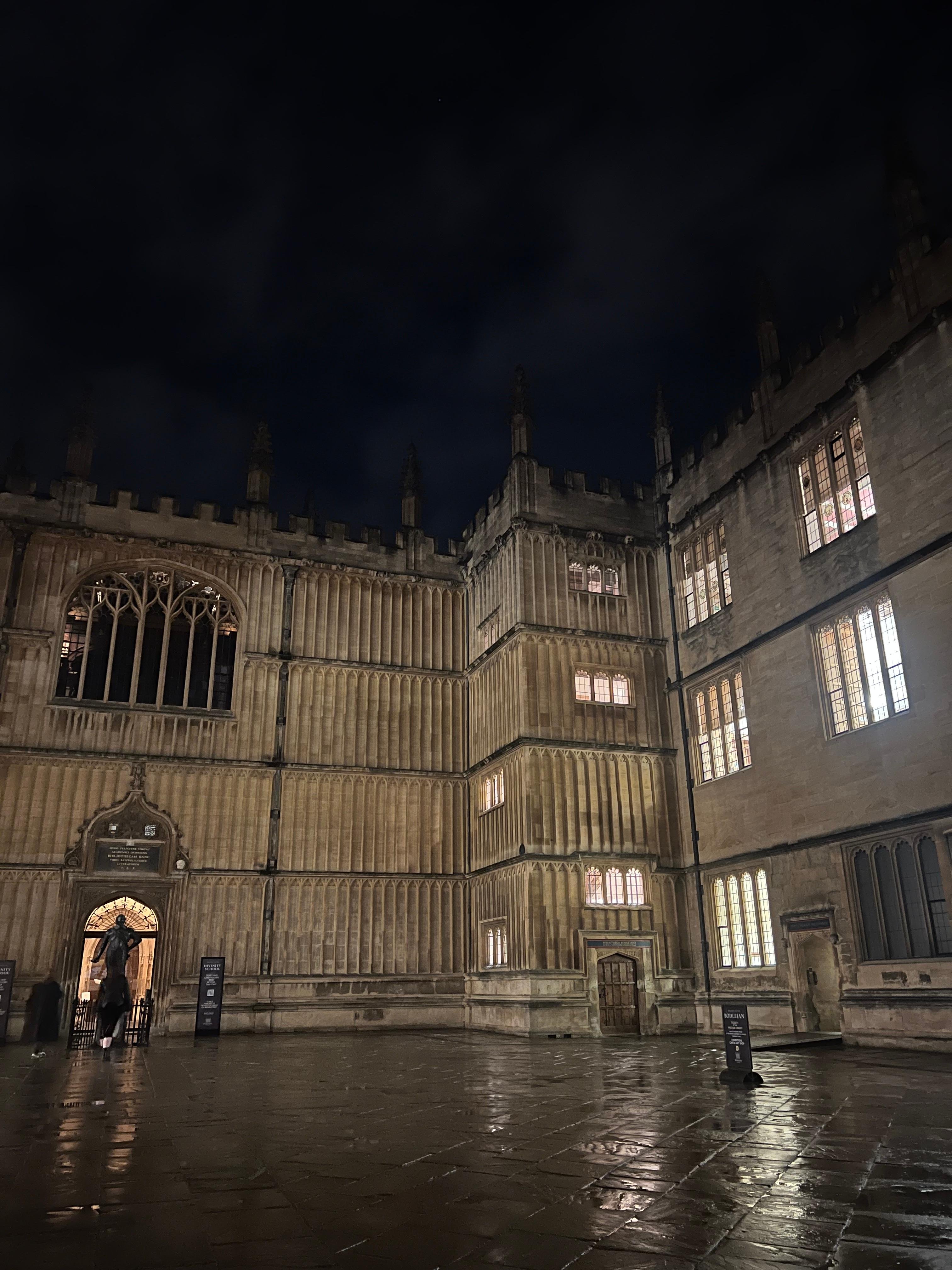
The most rewarding way to explore haunted Oxford is to begin with the place, then let the story change how you see it. A small cross in the road can hold the memory of a public burning. A peaceful meadow path can preserve a medieval funeral route. Behind a college façade, one locked box has sustained a century of library folklore. The history is strong enough that the legends do not need to be forced.
Broad Street: a cross almost hidden in plain sight
Start where Oxford looks least theatrical. Among the bicycles, buses and shopfronts of Broad Street, a stone cross marks the traditional site where Protestant bishops Hugh Latimer and Nicholas Ridley were burned in October 1555. Thomas Cranmer followed in March 1556 after rejecting the recantations he had signed.
The scale of the marker is what makes it affecting. It does not dominate the street. You have to find it, and once you do, the ordinary city around it becomes part of the scene. The Gothic Martyrs' Memorial nearby is a different object, erected in 1843. See both, but do not confuse the later monument with the execution place.
The cross is set into the road. View it from the pavement rather than stepping into traffic for a photograph.
Dead Man's Walk: the name has a history of its own
From the university core, continue towards Christ Church Meadow. Dead Man's Walk is often surrounded by plague tales and ghostly soldiers, yet Christ Church identifies a more specific origin: it follows the route used by Oxford's medieval Jewish community for funeral processions from the synagogue near today's Tom Tower to the burial ground on the site of the Botanic Garden.
That history changes the path. The avenue is no longer merely a suitably gloomy name on a map. It becomes a route of repeated loss, walked between a community and its burial ground. Later supernatural stories belong to the place's folklore, but the funeral landscape gives them a human foundation.
The meadow is generally a daylight experience and its gates can close because of weather or events. The Rose Lane and Merton gates are too narrow for wheelchairs and buggies. For a more accessible approach, use the War Memorial Garden entrance and check Christ Church's current notice before leaving the street network.
Queen's College: the scholar, the locked box and the library
The college frontage on the High Street offers no clue that one of Oxford's strangest personal stories sits behind it. Cuthbert Shields was born Robert Laing in 1840. He changed his name after leaving Oxford in the late 1870s, later renewed his connection with Queen's and left the college books and a locked box of confessional papers.
After his death in 1908, stories gathered around a white-haired presence in the Upper Library. One telling links the apparition to the opening of the box. Another remembers an elderly companion entering with a student and then disappearing. Queen's own account is unusually valuable because it follows the way dates, rooms and details shifted as the story was repeated.
This is a place to appreciate from outside unless you have authorised access. The Upper Library is not a casual visitor attraction. A good guide can bring the story into the street without treating a working college as an abandoned set.
Oxford Castle: where the legend has walls, cells and a shackle
At Oxford Castle & Prison, the haunted reputation attaches to spaces you can actually enter. Mary Blandy was convicted of poisoning her father with arsenic supplied by her lover, Henry Cranstoun. She was held at the castle and hanged on 6 April 1752. The attraction displays a shackle associated with her imprisonment, while later tradition places her apparition around the castle and mound.
The object does not prove a haunting, but it changes the story from a floating anecdote into the trace of a particular woman and a particular confinement. The same is true of the crypt, tower and prison wings. Their physical survival is what gives the later ghost stories somewhere to return to.
You can walk through the castle quarter freely. The interiors require a ticket, and the full route includes 101 steep spiral steps in St George's Tower. Our Oxford prison tour guide explains what the standard visit covers.
Magpie Lane: a short street that lets a guide earn the silence
Magpie Lane is central, public and easy to cross without noticing. Ghost tours have attached poltergeist traditions to it, while its narrow proportions make the surrounding college stone feel unusually close after dusk. The interest is less in a sight you can verify than in how the setting changes when a storyteller knows when to stop speaking.
Walk it as part of the city rather than as a destination that promises an encounter. Its value lies in the transition from busy High Street to a tighter, quieter lane, and in the stories a guide can place there without claiming that anything supernatural will happen.
A daylight-to-dusk route that makes sense on foot
This is an entrance-to-entrance sequence, not a promise that every college or meadow gate will be open. Check a live walking map and Christ Church's current gate notice before setting out.
Martyrs' Cross to Queen's College frontage
View the cross from the Broad Street pavement, then walk east, turn right into Catte Street and left onto High Street. Queen's main frontage is a street-level look-in on the north side of the High Street, not a through-route or promised interior stop.
Queen's College to Dead Man's Walk
For the direct route, continue east, use the signal-controlled High Street crossing by Magdalen Bridge and turn into Rose Lane. Its meadow gate is too narrow for wheelchairs and buggies. For the more accessible entrance, retrace west to St Aldate's and enter through Memorial Gate and the War Memorial Garden, then follow Broad Walk east. This adds distance and still requires a current check of meadow paths and gates.
Dead Man's Walk to Magpie Lane
From the meadow's northern paths, leave through Grove Walk for Merton Street, walk west and turn right up pedestrianised Magpie Lane to the High Street. If a gate or surface does not suit your party, retrace to Memorial Gate instead and treat Magpie Lane as a short out-and-back look-in from the High Street.
Magpie Lane to Oxford Castle
From the High Street, walk west to Carfax, continue along Queen Street and cross Bonn Square at the marked pedestrian crossings before following New Road to the castle entrance. Allow extra time for the High Street and Carfax crossings, and add at least 75 minutes if you plan to enter the prison attraction.
By daylight, this route gives you the geography. After dusk, a guided Oxford ghost tour gives you something the map cannot: the voices, pauses and connections that turn separate sites into one evening.
Meet the people before you chase the apparitions
Continue with Oxford ghost stories for the full tales of Mary Blandy, George Napier, Empress Matilda, the Martyrs and Cuthbert Shields. If you want to shape a meal and a tour into one unhurried plan, use our Oxford at night guide.
Further reading: Ashmolean: Oxford Martyrs · Christ Church Meadow · Christ Church Meadow Trail · Queen's College: If the dead can haunt us · Oxford Castle: Mary Blandy